

When people hear the word visionary, they often think of a very specific type of leader.
Someone bold. Someone loud. Someone with a big personality and an even bigger spotlight.
Names like Steve Jobs or Elon Musk come to mind. And with that comes a quiet, limiting thought many business owners carry: “That’s not me.”
Yet, being a visionary leader isn’t reserved for a chosen few. It’s not about personality type, charisma, or being born with something special.
It’s about how you see the world. And more importantly, how you choose to lead from that perspective.
Visionary leadership is not something you become one day in the future. It’s something you already have and can access more intentionally.

What Does It Really Mean to Be a Visionary Leader?
At its core, a visionary leader is someone who holds a clear sense of direction for the future and makes decisions aligned with that direction, even when outcomes aren’t guaranteed.
Vision doesn’t mean certainty. In fact, visions are often imprecise, evolving, and imperfect.
What distinguishes visionary leaders is not that they’re always right, but that they are willing to:
- see beyond immediate urgency
- make choices aligned with values rather than fear
- lead with intention instead of reaction
- create environments where people can grow
Visionary leadership is less about predicting the future and more about creating it. One decision, one mindset, one moment at a time.
Two Very Different Ways Leaders Show Up
If you’ve spent time in organizations, or built one yourself, you’ve likely seen both ends of the leadership spectrum.
Reactive, Fear-Based Leadership
This style often shows up as:
- constant urgency
- micromanagement and control
- difficulty delegating
- blame when things go wrong
- short-term decision-making
- emotional shutdown or avoidance
Leaders operating this way are often under immense pressure. Their focus is survival, not growth. Even when they “win” in a conflict, trust erodes, and teams disengage.
This kind of leadership drains momentum instead of creating it.
Constructive, Intentional Leadership
On the other side, constructive leaders:
- act proactively instead of reactively
- empower rather than control
- focus on solutions, not blame
- make decisions aligned with purpose
- handle conflict as a tool for clarity
- build trust, ownership, and accountability
The difference is profound. And it has less to do with skill and more to do with mindset.
The Seven Mindsets That Shape How You Lead
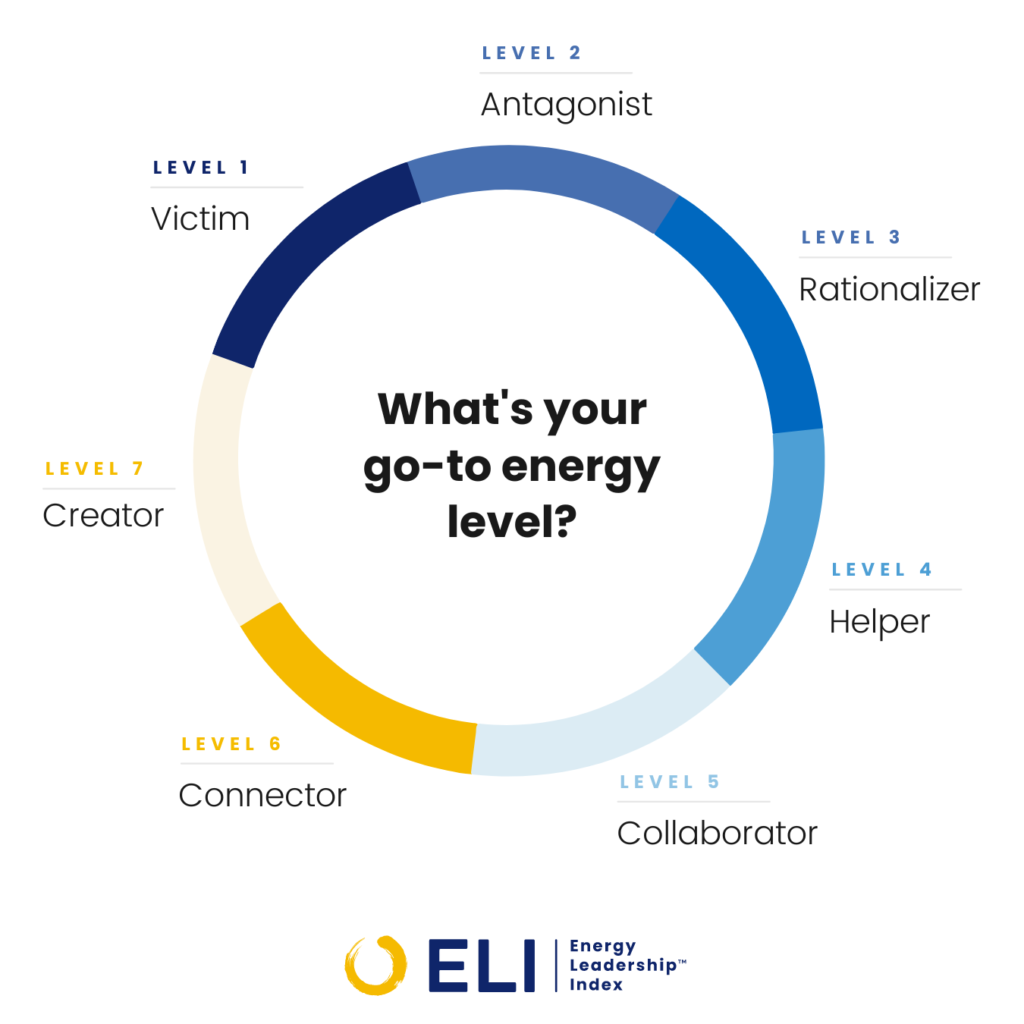
One helpful way to understand leadership is to think of it as a set of seven different ways of seeing the world (based on the 7 Levels of Energy framework created by iPEC and Bruce D. Schneider).
And you don’t live in just one forever. You move between them depending on stress, confidence, awareness, and choice.
The question isn’t whether you experience all of them. It’s which ones you operate from most often.
1. The Victim Mindset – “I Always Lose”
This is the mindset of powerlessness.
When leaders operate here, they feel:
- overwhelmed
- stuck
- reactive
- focused on survival
In business, this leads to avoidance and inaction. Progress feels impossible.
While everyone experiences this mindset occasionally, staying here long-term makes growth extremely difficult.
2. The Conflict Mindset – “I Win, You Lose”
Here, the world feels like a battlefield.
Everything becomes a zero-sum game:
- clients vs. business
- leader vs. team
- winning vs. losing
Anger, frustration, and competition dominate. Collaboration disappears. Over time, cultures built from this mindset implode.
3. The Responsibility Mindset – “My Results Are on Me”
This is a critical turning point.
Instead of blaming circumstances, markets, or other people, leaders here take full responsibility. They look in the mirror and say: “If my results aren’t where I want them to be, I need to change how I’m showing up.”
This mindset brings accountability, structure, and logic. It’s necessary. It’s stabilizing.
But on its own, it’s not yet visionary.
4. The Service Mindset – “How Can I Help?”
This is where leadership begins to open.
The focus shifts from self to others:
- customers
- teams
- partners
- communities
Leaders here lead from the heart. They focus on value, contribution, and support. Even difficult conversations become easier when the intention is to help rather than prove something.
Many businesses experience meaningful growth at this level.
5. The Opportunity Mindset – “We Can All Win”
Here, perspective expands.
Challenges become opportunities. Failure becomes learning. Leadership becomes empowering.
Leaders operating from this mindset:
- trust their teams
- encourage creativity
- build environments where people think and solve
- create cultures of engagement and fulfillment
This is where businesses often become not only successful but genuinely enjoyable places to be.
6. The Intuitive Mindset – “There’s More Available Here”
At this level, leadership moves beyond logic and emotion.
Leaders begin to:
- trust intuition
- create white space
- listen more deeply
- pause before acting
- tap into insight rather than urgency
Decisions feel aligned rather than forced. Vision becomes clearer, not because of more analysis, but because of more awareness.
7. The Visionary Mindset – “We Always Win”
This is not optimism. It’s perspective without judgment.
At this level:
- outcomes don’t define worth
- people are seen as whole and capable
- possibility feels unlimited
- creativity flows
- leadership integrates business success, personal growth, and positive impact
Visionary leaders here orchestrate.

Why Judgment Is the Real Blocker
One of the biggest differences between lower and higher leadership mindsets is judgment.
- At the lowest levels, judgment is directed inward (“I’m not good enough”)
- Then outward (“It’s their fault”)
- And eventually, it dissolves
When judgment fades, clarity appears.
Leaders can see:
- what’s actually happening
- what’s possible
- where growth wants to occur
Vision emerges from awareness, not pressure.
You Don’t Become Visionary, You Remember
This is the part many people miss.
Visionary leadership is not about adding something new. It’s about remembering who you already are before fear, pressure, and expectation take over.
You already have access to:
- responsibility
- compassion
- creativity
- intuition
- insight
The work is not to force yourself into a new identity, but to choose higher ways of seeing and responding moment by moment.
In any situation, you have seven options. Seven ways to respond. Seven ways to lead.
And the more often you choose curiosity over judgment, opportunity over threat, and alignment over urgency, the more naturally visionary leadership emerges.
A Simple Practice to Strengthen Visionary Leadership
You don’t need drastic change.
One of the simplest ways to access higher leadership mindsets is to:
- pause
- remove distraction
- suspend judgment
- create quiet
This can look like:
- sitting in silence for a few minutes
- taking a walk without input
- reflecting before responding
- allowing intuition to surface
Vision needs space. Without space, everything becomes reaction.
Final Thought
If you’re building a business, leading people, or shaping something that matters, you are already a leader.
And if you’re asking deeper questions about how to lead with intention, clarity, and purpose, you are already visionary.
The invitation is not to become someone else. It’s to choose how you see the world and lead from there.
Curious to discover your predominant mindset? Grab an ELI Assessment now.