

I still remember that first concert I attended. And then the first Christmas concert. This one was very special because I ended up writing my first poem after it. So, when Veselin Marinov published his autobiography, I had to read it.
I know, you have never heard of Veselin Marinov. He’s a Bulgarian singer. The thing is that he’s not one of those flashy performers. His songs are rarely played on the radio or national TV. Yet, every year, he fills halls, small and big, across Bulgaria, including what used to be the biggest one.
His story reminded me of why we started the business. And what building a visionary business is all about. It’s not loud. It’s not flashy. It’s about dedication, love, and passion. Day in and day out. And, here at Leficomp, we believe that every business can and should be a visionary business.

Visionary Business
I know. The phrase “visionary business” sounds like something unattainable. You are probably thinking of Apple or Tesla or one of these big companies led by extraordinary leaders. And this is what you’ll read if you check the description of the phrase “visionary business” online.
This is what Bing’s AI summary says on the topic: “A visionary business is led by leaders who anticipate future trends, innovate boldly, and inspire teams to achieve long-term transformative goals.
Definition and Core Concept
A visionary business is characterized by leadership that goes beyond day-to-day operations, focusing on long-term strategic thinking and the creation of new possibilities in the market. Visionary leaders are often entrepreneurs or executives who identify opportunities where others see obstacles, challenge conventional norms, and drive innovation that reshapes industries. They operate with a 5–15 year horizon, constantly envisioning the future and aligning their organization toward that vision.”
Well…
…let’s update this definition.
Our Definition of a Visionary Business
Let’s check some of the key points of the existing definition:
- Do you have to look into the future and shape it? Yes. It’s part of building a visionary business.
- Does it have to be 10-15 years in the future? No, not really.
- Do you need to innovate boldly and reshape industries? Nope. You need to innovate for sure, but it doesn’t have to be bold or industry-reshaping.
- Do you need to be a business leader who sees opportunities instead of challenges? Yes. This mindset is one of the key characteristics of visionary leaders.
So, what is our definition?
For us, a visionary business is a business, small or large, that creates harmony between profitability, customer satisfaction, employee growth, and overall impact.
That’s it. Simple and straightforward.
And here’s what you need to transform your company into a visionary business.
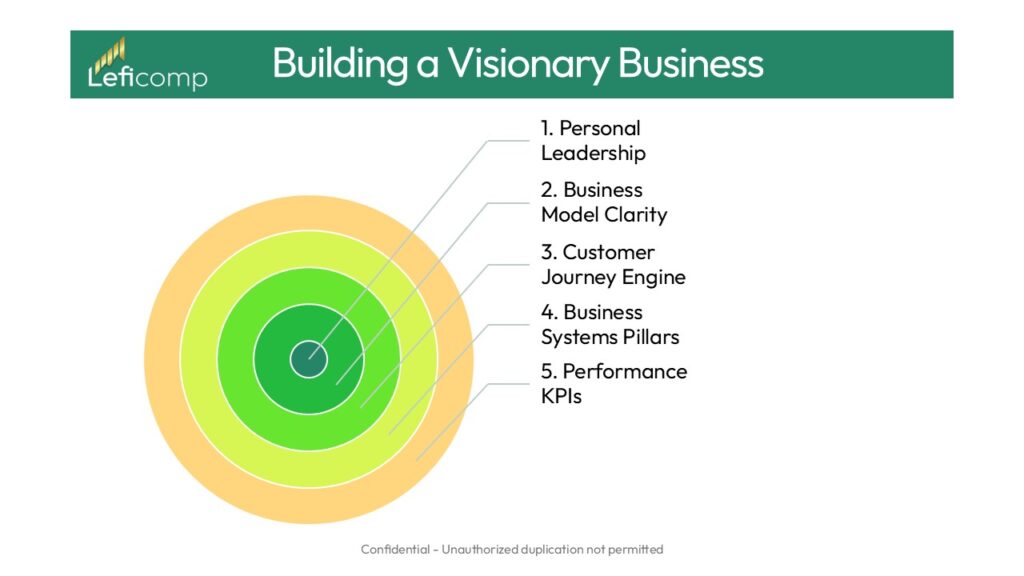
Building a Visionary Business
There are 5 main components you need to build a successful business. A visionary business. These are the same components we use in our work with solopreneurs who are ready to scale and grow their team.
We’ll review each component quickly, starting with the first one.
Personal Leadership
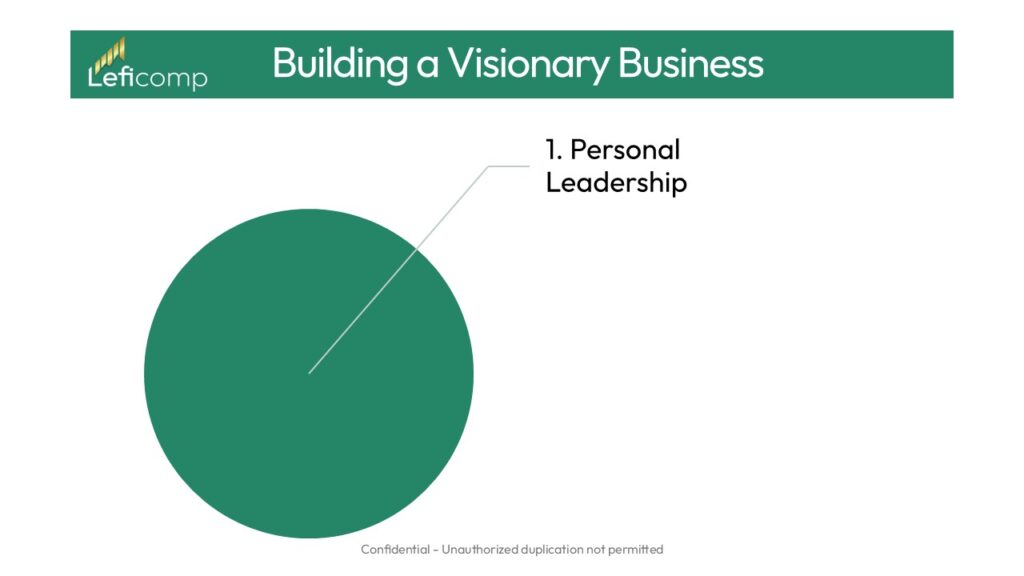
At the core of a visionary business is what we call Personal Leadership.
What do we mean by this?
First and foremost, it’s your leadership. You, as the founder, becoming a business owner. And, it’s a journey. Right now, you are probably a 6-figure business owner. And that’s fantastic. Yet, to transition into a 7-figure business owner, you need a new mindset. A new way of building and leading your business.
Second, personal leadership expands to the culture within the company. How every single person shows up.
When you think about it, it comes down to the mindset people bring into your business, starting from the top position down to the interns, if you have any.
Another way to look at it is that if you want to build a visionary business, you need visionary people who run and operate it. And, if you’ve read some of our past posts, you might already know what we are about to share.
For us, visionaries are people who operate with Levels 5, 6, or 7 mindsets as per the Energy Leadership framework created by Bruce D. Schneider and iPEC.
Which ties back nicely to the predominant definition of a visionary business. The one that requires leaders who see opportunities instead of challenges.
Yet, it also goes beyond it. There’s so much more that goes into the mindsets of Levels 5, 6, and 7. I can write (and will most likely do it) a full post on each of these. But, here, I’ll keep it shorter.
To help you see what we mean by personal leadership, here are a few key characteristics:
- Seeing opportunities instead of challenges
- Operating from all three: heart, mind, and gut (i.e., using emotions, logic, and intuition)
- Being non-judgmental
- Learning continuously both from personal experience and others
- Having a sense of connection with the world and the universe
- Truly caring about yourself and others
Business Model Clarity
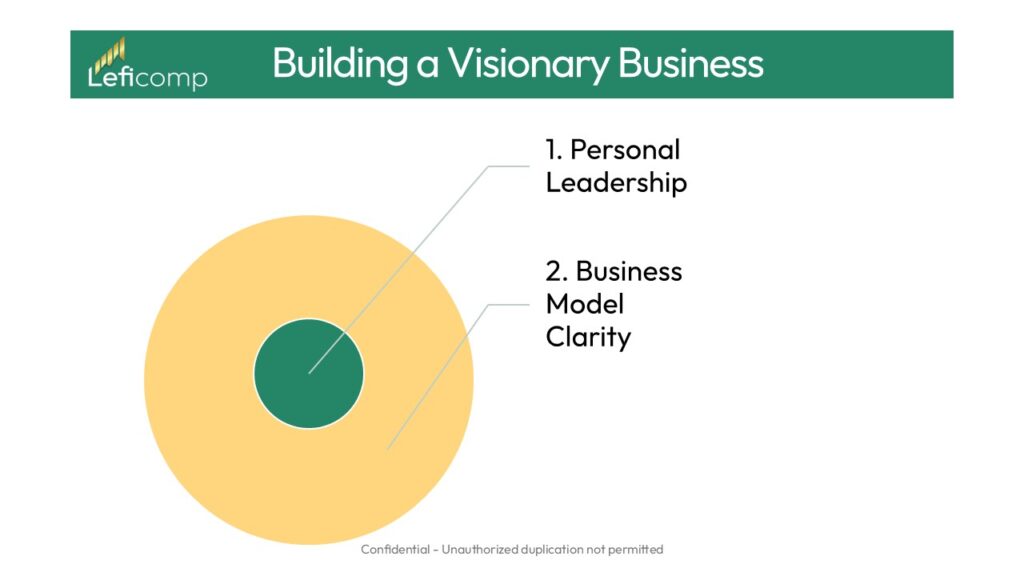
With the right personal leadership in place, it’s time to move to the business components, starting with the model.
You might be familiar with the concept. A business model is a strategic framework that defines how a company creates, delivers, and captures value to generate profit.
Some of the key questions a business model answers are:
- What problem are you solving?
- Who is your ideal customer?
- What makes your solution uniquely positioned?
- What is your solution?
- What does your revenue and cost structure look like?
This is a fundamental part of building a visionary business. If you can’t answer these questions clearly, you need to get back to the drawing board and understand how your business creates, delivers, and captures value to generate profit.
Customer Journey Engine
“If you build it, they’ll come.”
Not really.
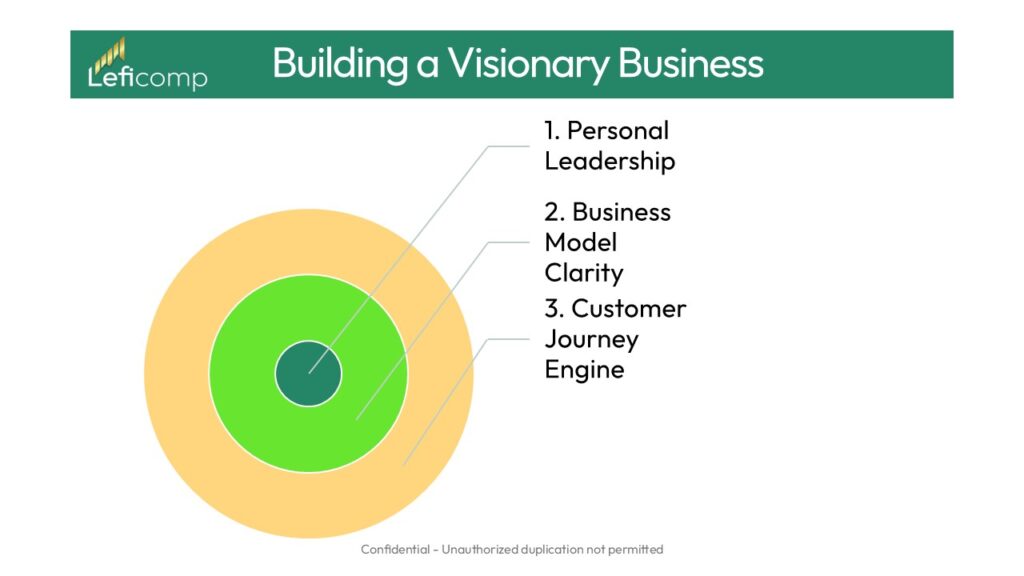
Personal leadership and a clear business model are key and the first layers of building a visionary business.
Yet, you don’t have a business if you don’t have sales. Actually, you need consistent sales that create profit, to be precise.
So, the next component in building a visionary business is what we refer to as the customer journey engine.
This is all about consistently attracting prospects, converting them into clients, and delivering the promised value (and even overdelivering). In other words, it’s the foundation of your marketing, sales, and operations systems.
It is truly like an engine for your business. Because it keeps it running and alive.
Business Systems Pillars
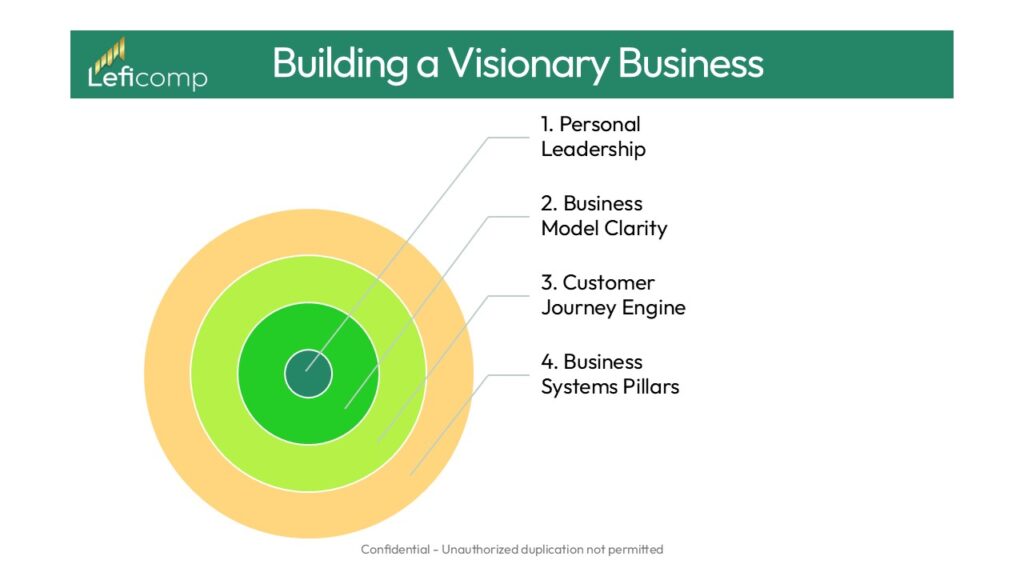
Marketing, sales, and operations are important. They are like the engine of your business. But they tell only half the story.
In our work with scaling solopreneurs, we evaluate and redesign the 6 business systems pillars of a visionary business:
- Leadership & Vision
- Financial Strategy & Management
- Marketing & Brand
- Sales & Client Acquisition
- Service Delivery & Operations
- Team & Performance Management
We do this to ensure that each critical function of the business is operating effectively and efficiently.
Because these are the pillars that support the business growth and sustainability.
Performance KPIs
We already wrote about the 4 KPIs we use and help our clients establish.
They come from our definition of a visionary business:
- Profitability KPI
- Customer Satisfaction KPI
- Employee Growth KPI
- Overall Impact KPI
What gets measured gets improved. So, if you want to build a visionary business, one that creates harmony between profitability, customer satisfaction, employee growth, and overall impact, these are the indicators you need to define and measure.
Simple and straightforward.
Bonus: Scalability Levers
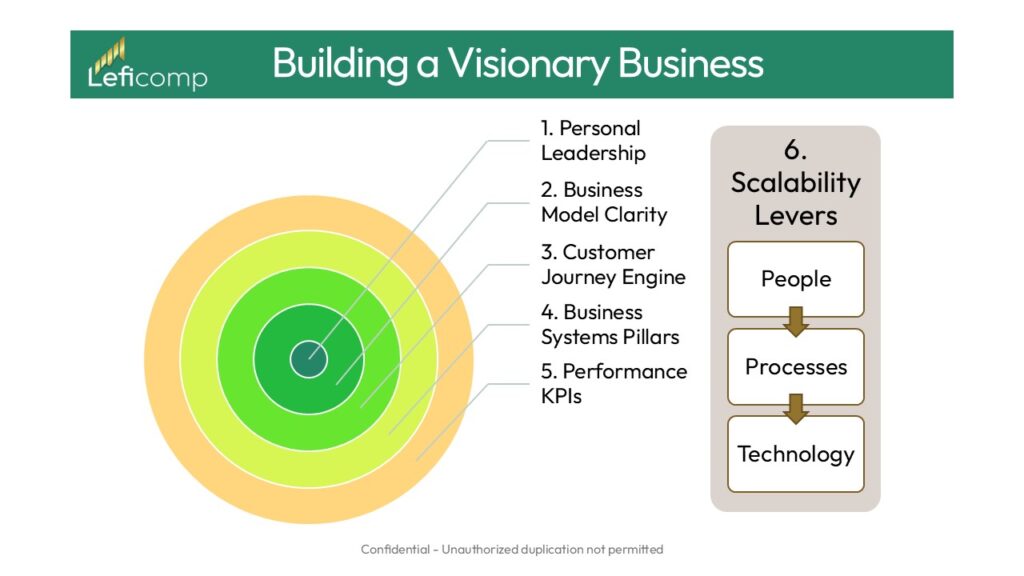
While these 5 components are everything you need to build a visionary business, there’s another layer that comes into play and is important to consider.
It’s a well-known framework in the business world. The idea that it’s all about people, processes, technology in this order.
In other words, to grow a business, you start with the people. Once you have the right people in the right places, you focus on the processes. Only after people and processes are correct, you focus on the technology.
One of the problems we all face these days, including us, is the rapid change in technology. There’s so much talk about AI and how it will completely remove a number of white collar jobs, that we all forget this fundamental truth. Technology comes last in a business. It’s an amplifier, not a solution. If your processes are not working, AI will only manage to help you fail faster. If you don’t have the right people in place, it will only lead to a quicker demise.
People first, processes second, technology last.
Oh, and that’s once you have the previous five components in place and working properly.
Building Your Visionary Business
Whether you are a lawyer building a law firm, a doctor focused on a longevity practice, a plumber growing a trades business, a baker operating a brick-and-mortar store, or a techie with a goal to create the next unicorn, building a visionary business is possible. And this is what you are here to do.
Because visionary businesses come in all shapes and sizes. Some impact the local community, others contribute nationally, and yet others leave a worldwide legacy.
What all of them have in common is the harmony between profitability, customer satisfaction, employee growth, and overall impact.
If you want to elevate your already successful business to the realm of visionary, you already have the ingredients:
- Start with Personal Leadership
- Ensure Business Model Clarity
- Optimize your Customer Journey Engine
- Strengthen your Business Systems Pillars
- Establish and monitor your Performance KPIs
- And finally, use the Scalability Levers
Simple and straightforward.
Because success in business and life doesn’t have to be flashy. It takes dedication, love, and passion to build something meaningful, successful, and impactful. And, as always, we are here to help on your journey of building a visionary business.