
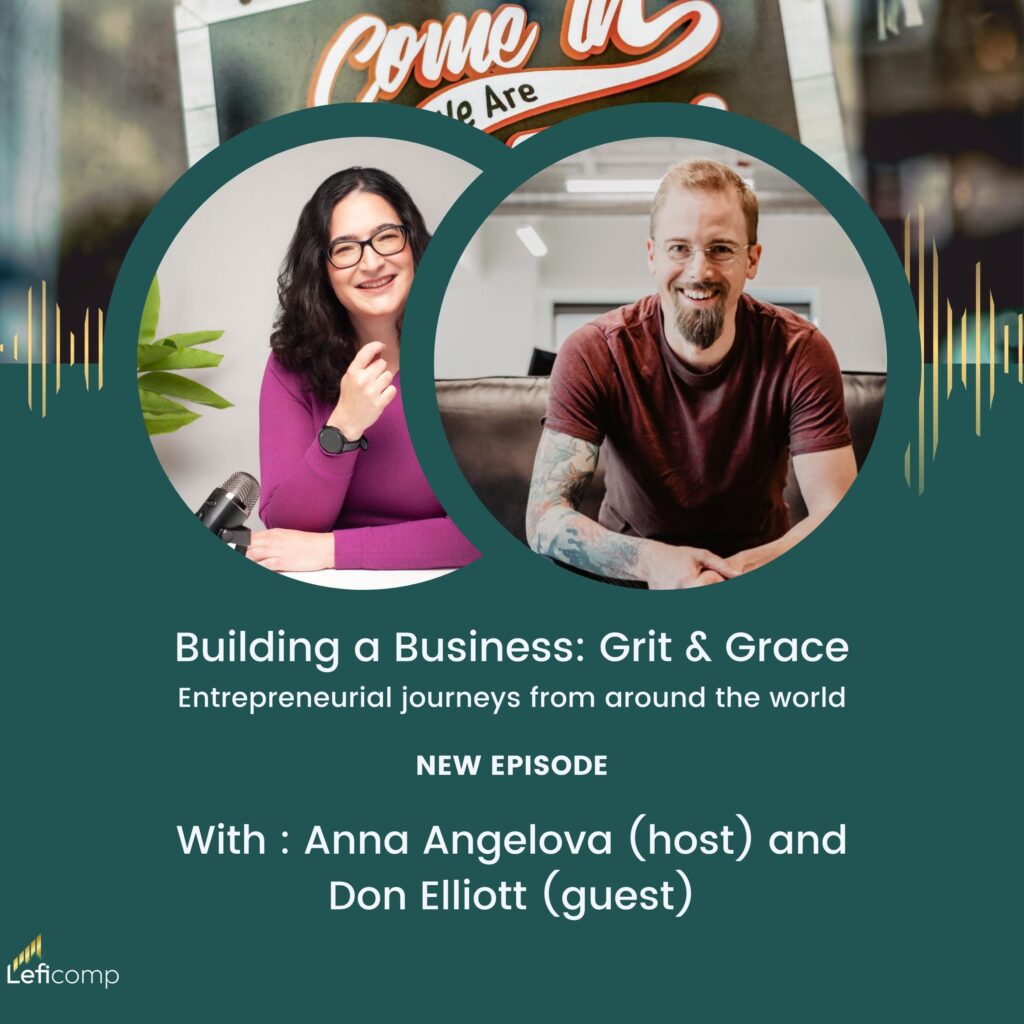
In this episode of Building a Business: Grit & Grace, we talk with Don Elliott, an entrepreneur, creative, and community builder whose story proves that business success can take many forms.
Don is the owner of Gravitate, a digital marketing and web design agency that’s been shaping online experiences since the dawn of the internet, and Pour Choices, a neighborhood pub in Vancouver, Washington, that’s become a local favorite for connection and creativity.
With nearly 30 years in marketing and creative leadership, Don shares what he’s learned from building, selling, and buying back businesses and why real growth sometimes means stepping away to return stronger. He opens up about the evolution of marketing in the age of AI, the unchanging psychology behind great advertising, and the importance of building a company culture rooted in trust and compassion.
You’ll also hear how running a local pub taught him lessons every entrepreneur can apply: that true success isn’t just about what you sell, but the experience you create and the relationships you nurture.
Listen now to discover how Don bridges creativity and strategy across industries and how you can apply the same mindset to build a business that lasts.
P.S. Don is also the author of a fantasy novel series. You can explore his books and learn more about his creative world at donelliott.us
Inspired by Don’s story?
Join the Visionary Founders Club (VFC), our global community for entrepreneurs who want to build meaningful, sustainable businesses with clarity, confidence, and purpose.
Transcript for “From Pixels to Pints and The Dual Life of Don Elliott”
The transcript below was automatically generated. Please ignore any errors or inconsistencies in the text. And have some fun with the made-up stuff. ?
Anna Angelova 0:05
Hi and welcome to a brand new episode of Building a Business, Grit and Grace. Today I have the pleasure of talking with Dawn Elliott. And Dawn, welcome to the podcast. I’m so looking forward to hearing more about you and what you do. So let’s start with the first question.
Who are you and what do you do?
Don Elliott 0:27
So I’m Don Elliott. I’m the owner of Gravitate, which is a digital marketing and web design company. I also own Poor Choices, which is a pub a little bit about a block and a half away from our house. So I’ve been in the marketing and creative industry for almost 30 years now.
Anna Angelova 0:44
I.
Don Elliott 0:47
And an agency owner for probably around 25, I think. So that’s me. I live in the Pacific Northwest, just outside of Portland in Vancouver, WA. And I’m kind of typical of people who live up here. So I’m into the outdoors and good food and good.
Anna Angelova 0:58
E.
Don Elliott 1:07
Beer and hence the pub.
Anna Angelova 1:11
Oh, wow, that’s fantastic. And you’ve been around for like 25 years with with the digital marketing. Share a little bit more about this business and like you did mention like it’s something I think it started in 1999. So it’s like even the the previous century.
Uh.
Don Elliott 1:31
Hey, yeah.
Anna Angelova 1:33
Um.
Don Elliott 1:33
Yeah, so Gravitate began at the very beginning of the Internet, arguably, at least as far as the Internet becoming mainstream and and commercial. I had started my own agency, so Gravitate started with different owners initially.
And then I had started my first agency in 2000.
Two, I want to say and built that up. I had a couple partners. We built that up and then I sold my shares back into the company. I moved on and created another agency called Elliott Design and then Gravitate came and bought my agency in 2012.
And then I took over as the as the new head of operations and ran the company for about four years. And then I left and honestly, I just needed a break from running agencies. And so I decided to do consulting for four years.
A little less than four years while I was figuring out what else I wanted to do. And in the meantime, Gravitate fell into a position where it was very attractive to buy back. So I came back on March 2nd of 2020 and and bought the company.
And then running it again ever since.
Anna Angelova 2:52
Not a very linear path. I love it. You started with one agency, then you build another one and you took some time off, which shows you that business ownership is not you started and then you just do this the whole time.
Don Elliott 2:57
Right.
Anna Angelova 3:11
And you’ve been in this industry for a lot of years now and you said that some of the things back in the early 2000s is completely different from what we see now. So what did you say are some of the biggest shifts you’ve seen, particularly in the marketing industry?
Don Elliott 3:27
Yeah, so marketing has gone through many evolutions since since back then. Definitely the biggest impact was social media itself. So before social media, SEO search engine optimization was the main play and it was relatively easy to do really well.
And so Gravitate really succeeded for quite a while just off of that. But now it’s incredibly complicated. There’s so many moving parts and with the introduction of AI and platforms like Meta that are kind of forcing AI on people.
It’s the amount of levers you need to turn, the amount of things you need to tweak and mess around with are astronomically higher than they were 20 years ago agencies. It used to be that you could have a full service agency and you would be pretty good at everything you did. You’d be doing billboards and video.
And websites and this whole shebang. But now it’s so nuanced and so complicated that agencies have become much more specialized. So for us, we deal directly with digital marketing. We don’t do traditional marketing. We have partners who we bring on board for clients who need that.
But to be relevant and to be sharp and to stay on top of things, agencies really have to specialize now.
And as far as on the client side, for companies who are marketing, there’s been different trends that have come through. So for example, when COVID happened, there was a big push for.
Authentic content, which is still the case, but unpolished content. There was a sense of, you know, we’re all in this together. The world’s falling apart. You know, there’s all this chaos and and confusion. And so people didn’t want to see these polished, really refined executive videos.
They wanted to see somebody with a camera saying, hey, my life sucks right now too, you know, let’s talk about it. Since then, what’s interesting is now there’s a trend that’s almost in the opposite direction. Still authenticity, still.
Keeping it real, so to speak. But people do want to seek brands that are more polished and more so they’re not fly by night. They’re going to stick around. And again, it’s because of the the temperature of the of the market right now with all the chaos in the various governments around the world and.
You know, wars and things like this, people are wanting to see some stability. So those trends come and go. But the I’d say the real big difference is just the amount of tracking, attribution and complexity of marketing now is is.
Doesn’t compare at all to what it was 20 years ago.
Anna Angelova 6:23
Oh yeah, a lot of things have changed. And one thing that you mentioned as well, thinking about like with AI, how many new apps and businesses are coming up that I I’m not surprised that you’re seeing people who are looking actually for stability knowing that.
Don Elliott 6:27
OK.
Anna Angelova 6:41
The company will be there. It’s it’s not something that just pops up and disappears. So very, very, very interesting observation. You did mention clients, so I’m actually curious what type of clients are you working with?
Don Elliott 6:59
Yes. So we work a lot in, we do work with a lot of nonprofits. We’re primarily small and medium-sized businesses. We do quite a bit in travel and tourism and then a lot in tech start-ups.
And in particular in infrastructure. So things like data storage, cloud security, that kind of thing, which is a lot of the infrastructure that backs AI. So it’s a good position to be in and to know about, I’d say overall.
We are largely AB to B company. We have some B to C clients that we do really well good work for. Um, but our specialty is more in in B to B.
Anna Angelova 7:43
It.
And you know, sometimes we forget, we look at things that change, right, the trends that come and go and things that change. But sometimes we forget about the fundamentals that are still the same even now in 2025, at the end of 2025 almost.
So I’m curious with your experience, what would you say are some things that were true back in the early 2000s and they’re still true now?
Don Elliott 8:12
So human psychology, that hasn’t changed. The fundamental principles of advertising are still the same. You want to speak to people’s fears. You want to speak to their aspirations. You want to convey the why, which has become somewhat of a cliche in marketing, but it’s a cliche because it’s true.
Why does this matter to me? So it’s cool that we have to put an ad that’s gonna syndicate on LinkedIn. It’s slightly different on Google search and slightly different on Meta. And then there’s gonna be an e-mail and all this coordinated complex activity is all cool.
But at the end of the day, there’s still words that somebody’s reading, and those words need to inspire. They need to convey emotion, and they need to capture somebody very quickly. Because even 20 years ago, people’s attention spans have never been very long for advertising. You’ve always only had a few seconds to really.
capture somebody, whether it’s a Billboard or a TV commercial or or a digital ad. So that human psychology is still the same, which is one of the frustrating parts that we have to deal with as an agency is Google, for example, removed the ability to use your own copy.
So instead of us being able to say an ad that’s compelling and that has, you know, a good hook to it, Google now forces you to put in terms. So and then it uses AI to decide real time what the ad should say.
And it’s horrible. So for example, we had an advertisement that went out for us that said industrial web design for industrial companies.
Anna Angelova 9:44
Mhm.
Don Elliott 9:53
Like that one in a past, you know, a one-on-one marketing class test. You know, there’s nothing compelling about that. There’s nothing emotional. There’s nothing aspirational. It it’s it’s meaningless words. But Google has stripped that, right?
Right from advertisers because of AI. Yeah, it’s an interesting change. It’s pretty upsetting to the rest of the industry because historically the power of advertising was in the words and visual second.
Anna Angelova 10:10
Oh.
Don Elliott 10:24
And well, visual first for capturing the the attention, but the words is what brings it all home. And now we don’t have that control and Meta’s starting to head that same direction. So that’s a pretty big upset in the ad industry.
Anna Angelova 10:39
Wow, I didn’t know about this. It sounds like I would be upset like if I if I was doing even just as a user, I would be upset if this happens well.
Don Elliott 10:48
Yeah.
Anna Angelova 10:55
I have not had no idea, which actually bring me to another question. I’m curious. It’s definitely a very interesting industry to be part of a quick, like you said, the human psychology itself and the way we haven’t changed.
Don Elliott 10:57
Yeah.
Anna Angelova 11:14
So what brought you to to marketing actually in the first place?
Don Elliott 11:19
Yeah, so growing up I was always creative. I was a writer and and a drawer and was into painting and all that kind of stuff. So the visual arts and the literary arts really appealed to me.
But I actually started off in a non-profit organization and managed to gain some traction there. And So what what happened was I had essentially become the the general manager of this non-profit that had multiple businesses like a coffee shop and some.
Other things and the.
There was the former chief of staff for the mayor of Portland lived in the neighborhood, and so he was seeing all the changes we were making and how good, what a big impact we’re making in the community. And so I was invited to go and help consult with other.
Companies that were on different streets that are being revitalized. And during that process, I was very young. I didn’t know what I was doing at all, but I had lots of ideas. But during that process, what I realized was most of those businesses knew how to do what they were offering. If there was a creperie, if it was.
A music school, they were good at doing what they did. What they generally weren’t good at, sometimes it was finances, a lot of times it was finances, but most of the time it was marketing. And so we were constantly bringing in these marketing agencies to help these businesses.
And meanwhile, a friend of mine had graduated from Idaho State or University of Idaho, one of those two, and with a design degree, and he was super talented. So we went in with one other partner and started our own agency.
To service those needs and then it kind of took off from there. So I I sort of fell into marketing because that those were the doors that opened up and it aligned with my skills and talents at the time. But I didn’t go to school for it. I I never did any kind of training or anything like that, no certifications.
Just kind of delve in.
Anna Angelova 13:30
Yeah, these things are, like I said, sometimes life takes you there and like to experience the fact that you also saw the opportunity, like you saw the pattern that all the these businesses are great at what they do, but a lot of them.
Like I said, finance is a big thing. Marketing another another big thing. They don’t know how to do this. You saw the opportunity and you took it, which is something that entrepreneurs do. And you’ve been on the two sides of like you mentioned that.
Don Elliott 13:53
Yeah.
Anna Angelova 14:03
With your second business actually gravitate both, both it, right. Like this is how you, this is how you ended up with working with them. And then you’ve also been on the other side where you were the buyer. So like I’m curious to hear a little bit more about these stories, what it’s like to.
Don Elliott 14:17
Yeah.
Anna Angelova 14:22
Sell your business and then what it’s like to buy a new business.
Don Elliott 14:27
Yeah, so um.
Selling the business was a lot easier than buying it. I found because when I sold the business, the SBA and that first deal selling Elliott designed to gravitate, the SBA wasn’t involved. It was just a private matter and.
We did a business evaluation and came to an agreement on the terms and they paid the money and we merged into their company. It was really pretty straightforward. I think it’s about a three month long process.
Learned a lot in that process. So I thought I was asking all these very smart questions and the things that I didn’t ask that I would have now in retrospect is one I would have asked to interview people from the staff, the current staff.
I only spoke with the leadership, but I I I would have liked to have spoken to regular staff members to get a more authentic view on how the company was being run, because what we discovered was the company was being run very poorly and they were in a really bad situation.
So, but their numbers looked good in PNL statements. So numbers don’t show you that 70% of the staff is about to leave. The numbers don’t show you that they’re pending lawsuits happening.
Anna Angelova 15:50
Yeah.
Don Elliott 15:55
You know, things like this, major issues. So I learned a lot about what to ask, asking about their operations and processes and how are they actually fulfilling these clients.
We dove into that a little bit. I wish I would have dove into that more. And the only reason I say that it it wouldn’t have changed me selling it. I still would have sold, but I would have come in with a much clearer understanding what the next few years were going to look like and what my role was going to be in that.
And I would have come in with some additional demands on what my authority was going to be like from day one, things like that. Because once we got into things and the company, I was turning the company around, the other owners and I had some disagreements on where to take the company.
When I left, we left amicably. We left as friends, so it wasn’t a toxic thing, but we definitely weren’t on the same page. Um.
Now selling the company much more complicated, but also we were we worked with the SBA for or not selling buying the company. Sorry. When I came back and bought Gravitate in 2020, we did an SBA 7A loan.
And um.
That was the the bank we worked with was absolutely the worst banking experience of my life. They were so incredibly incompetent. The deal almost fell through twice because of their negligence. So really being diligent on having a bank banking partner that one.
Anna Angelova 17:23
Yeah.
Don Elliott 17:38
The person who’s your point of contact isn’t about to retire because our point of contact retired one month after the deal was closed and we found out why he wasn’t putting any effort into it to a bank that can actually breakdown the process to you clearly.
Anna Angelova 17:42
Oh.
Don Elliott 17:54
And say this is exactly what’s going to happen, but the three is just.
It’s worthwhile meeting multiple bankers until you find one that you believe has really the energy and the drive to make the deal happen. Because a lot of bankers are there to check boxes. They’ve got a salary, they’ve got a gig. They just want to go home to their wife and kids or, you know, husband, whatever.
Whereas if you can find a banker who is passionate and they care about the deal and they want to see things come through, they want to see you set up properly, the process can be a lot smoother.
So that was we had to come to an agreement again. It was kind of funny because they bought my company and then I came around and bought their company. So we were going through similar processes together. We had to come to an agreement on what the company was worth and that was.
Um.
Fairly complicated because it wasn’t just having a business evaluation. We had to agree on, you know, how many leads they get a month, how much is that worth? What’s the value of a retainer for growth marketing versus a retainer for hosting?
Because those are different types of engagements, and so it was definitely a lot more complicated than buying the pub. Buying the pub was easy as well.
So yeah, that’s a kind of it in a nutshell.
Anna Angelova 19:24
You mentioned buying the pub, but this was something that happened very, very recently. So with this one, it’s kind of completely different from marketing. So why? Why buy a pub?
Don Elliott 19:36
Yeah.
Yeah, so the pub is a really unique thing. It’s it used to be called Doomsday. It’s now called Pour Choices, B-O-U-R Choices. And they were a brewery before and a whole community of people have built up, had built up around it. And so we had.
Anna Angelova 19:49
Oh, OK.
Mhm.
Don Elliott 19:58
Lots of friends and acquaintances there, but the previous owners really wanted out and so I approached them about purchasing it specifically because I were part of that community and we wanted to keep it going. It’s very arts focused. We have.
Every month is a new featured artist. We have jam nights and live music and karaoke and all kinds of things going on. So I saw it as a way of giving back, but also a way of sort of memorializing or retaining something that was really important to me outside of money.
So it’s a small place, you know, it’s not a big money maker. It’s not something I’m ever going to retire off of. But but there’s a lot of passion behind it. And it’s interesting to me because I can have Gravitate and we can do a $200,000 website or, you know, a $200,000 retainer and we can see all the.
Move up and to the right and we’re seeing results, results, that’s fantastic. This website performs really well. That’s fantastic. And that’s all still abstract. We’re looking at charts. We see that the founders of this company were able to buy a new house. There’s things like that that are rewarding and fulfilling, definitely.
But the pub is, I’ll stand across the street at night and look inside the windows and see friendships being made, you know, and people laughing and having a good time. It’s very concrete. It’s very real. And so, Gravitate, you know, we work with nonprofits and we watch literally child
infant mortality go down as a result of our efforts. You know, incredible things that make a real impact in the world that are meaningful. But there’s something about seeing people live in in the real world, experiencing something wonderful that is incredibly fulfilling.
Anna Angelova 21:54
Yeah, I can understand what you’re saying because with the marketing like you are, yeah, you can see the impact, but you are a little bit behind the scenes like you’re in a way the back end. But with the pub you were there, you were in the midst of this and seeing seeing that the impact that you’re making.
Don Elliott 22:06
Yep.
Anna Angelova 22:14
It’s so beautiful and that’s like, I’m so happy to hear this story and I’ll just quickly share. We actually went to Des Moines this year recently and on our way we stopped in Michigan and we were watching Guy.
Don Elliott 22:14
Yeah, exactly.
Anna Angelova 22:33
Pieti, the diners, dive-ins, this one. And he was talking about a place in Des Moines that was a drive-in like you go with your car, you were in your car and they bring you the food. And the owner was saying how he was showing the pot from his dad.
Don Elliott 22:37
Yeah.
Anna Angelova 22:51
And his dad was on a World War 2, like he was in World War 2, and the pot was actually from there, engraved and everything. Long story short, it turns out the owner passed away and no one took over that business. And it’s not there. It’s closed. It’s been closed for I think 20.
19 and we wanted to visit it and we felt like such a bummer that something there was the locals loved it. People were going and experiencing it and what you did with buying.
Don Elliott 23:16
Uh.
Anna Angelova 23:27
A local pub, something that, like you said, it’s not big, but people come in, people, people form friendships there. I find this fantastic, the fact that you’re continuing this. So really appreciate this and definitely would love.
Don Elliott 23:44
8.
Anna Angelova 23:45
To visit it one day, poor choices. Sounds like a really cool name. back-to-back to business, actually, so.
Don Elliott 23:47
Yeah.
OK.
Anna Angelova 23:57
When you think about the two different businesses you have like with the the marketing and the and the pub.
In terms of lessons that you’ve learned, although like with the pub, it’s been just a year and a half or so. What would you say are some lessons that carry over between digital marketing and the owning a pub, running a pub?
Don Elliott 24:22
Yeah. So there’s quite a few crossovers. One thing is that when when I talk about business, I often talk about how it’s it’s the marketing and the management that matters. The product doesn’t matter. The product is a catalyst.
So you can have a really bad product, but a great experience and you’ll retain people. You have a really great product and a bad experience and you won’t retain people. Walmart, you know, made their whole stick on really cheap stuff.
They weren’t a luxury item. They didn’t try to say they were high quality. They said you can get a lot for a little from us. Pet rocks, you know, there’s there’s countless examples of it doesn’t really matter what the product is, it matters how you market it. So for us.
At the pub, we sell beer and wine and cider and that kind of thing. And you would think that’s our product, but to me it’s not. That’s just, that’s just the thing that we sell. What you’re really coming there for is the experience. It’s the people that you meet. It’s the person behind the bar who’s serving you.
And it’s this entire experience that you’re having. And it’s the same with Gravitate. Anybody can serve beer in the same way anybody can get good SEO results or good paid advertising. There’s plenty of agencies who do what we do, and they do it well.
The difference is that we value that relationship and the actual experience much more than than a lot of agencies do. So one of the things that we did was we got rid of account managers, which is very unusual for our industry.
Typically you have the client and then you have an account manager and then you have the team doing the work, and usually that team’s led by some kind of strategist who, you know, knows what to do. So we removed the account manager and now the clients deal directly with the strategist who’s being held accountable for the results.
And that strategist still has a team of people that they can work with, but they’re the ones who are setting the actual strategy, the tactics. They’re the ones that when my VP meets with them on a weekly basis, they have to show the results of all the clients. So that experience is really key to our success. It shows clients that.
We care that we’re compassionate, and the exact same thing applies to the pub. People coming in, they want to see care and compassion, that it’s more than just the beer or the SEO results.
Anna Angelova 26:58
Very well said having that experience and being focused on your customers, whether like it’s in the pub, someone having a beer or if it’s your B2B client getting the digital marketing strategy.
Now you did mention a little bit when when you talked about the experience of selling your own business, you did mention a little bit about that you wishing to talk with some of the other people, not just the management, which actually made me also think about.
Culture. Building company culture.
Don Elliott 27:37
M.
Anna Angelova 27:37
So.
Tell me a little bit more about this and that you could share for both businesses. I know like the top is something newer. How, how are you doing this? How are you building, fixing things? Because I can step actually into existing businesses and I can imagine that there might be things that.
Are not working as well as you want them to be.
Don Elliott 28:03
Yeah, yeah. So culture to me. Um.
There, my basic philosophy is you first have to do your job to really hire the right person. And that’s probably the hardest part of the whole thing is hiring the right person. And we could talk a lot about what that means, but once you hire the right person.
They need to have the vision and guidelines necessary to know what their job is, but then after that you need to get out of their way and let them do their job. So the way I see it is I I try to hire people that are as good or better than me at what they do, preferably better.
And and then, you know, we make sure they understand here’s the vision of the company, here’s our values, here’s where we’re going. This is the kind of expectations we have for clients. And here are the tools that you can use. Now go forth and do it and.
Let me get out of your way. I’m not going to be double checking all of your work. I will be there as a resource. I will be there to remove obstacles that you can’t remove. But you’re the one who’s going to be running forward and making this thing successful. And I do the same thing with the pub. So it’s all about empowerment.
If somebody believes that they have trust, so when they know that I trust them, they rise to the occasion. And when they know that their ideas matter and that they’re going to be heard and that they have influence, they rise to the occasion. They also stay around a long time.
We have employees who have been with us for for many years despite having gone through downturns and rough periods because they know that they have impacts and that they matter, that they’re seen. I make sure to spend time with all of my employees one-on-one.
And it’s all about hearing ideas. I think a big part about culture is we talk about inspiration a lot, and I’m known to give some, you know, flowery speeches here and there, which are fun and they’re inspiring in the moment. But really, what inspires people is believing.
That they’re a part of something bigger, and sometimes that’s just reminding them of their career. Yeah, you’re doing this task right now and it sucks, but it’s a task we’ve got to do. But it’s putting you in a position for your career to take this next step.
Whether it’s with us as a company or not. And so you’re reminding them of the bigger picture in their own life. And as a result, you get you, you earn loyalty and you earn passion from them. The moment you start taking away from that, the moment you start micromanaging.
Then it becomes, you know, well, I’m just a cog in the wheel, so I can work anywhere. So I’m going to go to whoever pays me the hives and you don’t have that kind of longevity with your employees.
Anna Angelova 31:01
Yeah. What I’m also hearing when you’re sharing this is caring about them. Like what you’re saying about that putting that, having that reminder that sometimes it’s about their own journey, that it’s about their own career and taking them to the next step. Because again, like especially with the marketing when you.
Don Elliott 31:09
Yeah.
Anna Angelova 31:21
Are working back end and creating something that you’re just doing something that is at least one or two steps removed from seeing the real impact. Yeah, you can be wondering why am I doing this? What’s the purpose of it all?
Don Elliott 31:29
OK.
Yeah, yeah. I was asked in another podcast, somebody asked me if AI was gonna take my job in the future and and I said no very confidently and and the reason I believe that is that.
Anna Angelova 31:38
Mm.
Mhm.
Don Elliott 31:53
My job is when an employee is overwhelmed and they’re dealing with depression and they can’t get out of bed to call them and to talk them through it and to hear where their problems are and to remind them of the bigger picture, to give them time off if they needed to recover from whatever it is they’re dealing with.
A I cannot deliver that kind of compassion because even if it has better word choice than I have, you know the A I doesn’t care about you, whereas I’m going to be there as another human who gives a Dang about what your job is and where you’re going in your life and how you’re succeeding and all of that.
So as long as we still need any level of leadership, there’s still roles for leaders to be played, and I don’t see AI taking leadership anytime soon.
Anna Angelova 32:35
E.
Oh yeah, definitely. It’s a it’s a tool. It’s a tool for certain things and they say it like any other tool. So like you said that human to human.
Conversation and especially when you need your leader to show up. Speaking of leadership, you did mention that like you had partners, but I’m actually curious what it is like like some of the pros and cons of having partners with you.
Don Elliott 33:14
Oh, I’ve got lots of stories about that. My first partnership and the first agency I started with, the friend I had mentioned that one, the financier we brought in was his uncle. So it was a nephew and uncle and me.
And a lot was uncovered later on in in how they were handling their finances. And so that’s why I sold my shares back into the company was because they were doing the fairest activities. I didn’t want to be involved in it, so I got out.
So that first partnership.
You know, I think going into a partnership where you’re not the family member and the other people are is already a red flag that, you know, I was young so I I thought it wouldn’t matter. My partnership structure for gravitate right now is I own 70%. So they’re the other three are silent partners essentially.
I get their feedback, lean to their advice. You know, we we’re in constant communication, but I’m the sole decider for the business, which makes it much easier to run the pub. On the other hand, there’s five of us and we’re all equal partners.
Anna Angelova 34:29
Mm.
Don Elliott 34:31
And there’s couples involved. There’s my wife and me. There’s another two gentlemen that are married, and then a gal makes up the five of us and we are.
You know, that was difficult at first. Lots of fun and excitement, but also very difficult at times. We had to work through some kinks. We had to learn each other’s communication styles because even though we were all friends beforehand, business makes people different and you perform differently. It’s like a football player on the field versus off the.
the field, you know you perform differently. So we had a lot to learn and to work through. But I think the reason it works for us is the pub is not there to make money. It needs to make money. We want it to make money. It needs to pay its bills.
But it’s there for the community and for the passion that we have for it. So if I was in the pub and it needs make money so that I can pay my bills, I would not have equal parties. I would have deciding say in it.
Anna Angelova 35:36
Mhm.
Don Elliott 35:39
I have come to learn that um.
I work very well with others, but I stress out when I’m having to. When let’s say we have a group of people, we come together and there’s one leader who decides we’re going to do XY&Z and I don’t agree with XY&Z. It’s very difficult for me to be on board. I’m not great in that regard.
It’s easy for me to take a back seat. I love it when somebody else wants to leave. So it’s not a control factor in that regard, but it is a control factor in that it’s it’s like grating against my soul to perform an activity that I don’t believe in.
So for me, it’s a lot less stressful being a business owner just on that, um, in that regard.
Anna Angelova 36:26
Very interesting point there like because the pub is more of a like something you’re doing for the community and yes like like you said you want it to you know cover cover at least the expenses and it’s not it’s not there to to as as your main source of.
Income, revenue, these kind of things that this is one of the reasons why it’s working out having having five partners ultimately. But then if it was the main one, it would have been a completely different story. So it’s great for everyone listening. This is a great point to think about when you’re getting.
To partnership the good and the bad things about this. Building a business is not easy on its own and having those things with partners is also adds a different layer of complexity.
Now you did mention for the pub that you are, it’s for the community and this is something you love about it and that you you have different teams for for every month. So it’s more of like there is some art, like art involved there. So can you share a little bit more about this?
And maybe what’s coming up in the next few weeks and months, like the holidays are here, Thanksgiving, Christmas.
Don Elliott 37:40
Yeah.
Yeah, yeah. So we focus the pub a lot on the arts in general. So every month we have a different featured artist on the walls and and the arts for sale. And so that’s rotated every month. So every month there’s kind of a slightly different vibe in the pub, which is pretty cool.
And the artists do really well. They sell, you know, pretty consistently 12 to 16 pieces every month, which is really good. And then we have.
Trivia on Mondays. We have a jam session on Tuesdays, which is where a bunch of musicians come in together and the place is packed and they’re all rocking out. It’s really fun. We do bingo on Wednesdays. On Fridays we have live music and that’s also always local musicians.
And then karaoke on Saturday and Sunday’s like a writers group and tabletop gaming and that kind of thing. So we’re we’re trying to have something going on pretty much every night of the week.
Anna Angelova 38:50
Oh, sounds so interesting. Like this can keep you coming back every every week, every day of the week, because there’s something going on, something different.
Don Elliott 38:58
Yeah, yeah. The whole model is built around regulars. You know, it’s the the the two neighborhoods. Well, there’s several neighborhoods here, but the two main neighborhoods here, the historic neighborhoods and just regulars who come in all the time.
Anna Angelova 39:12
Mhm.
Don Elliott 39:12
Is really the the the whole model.
Anna Angelova 39:15
Well, you are in marketing, so if I don’t ask you this question, if I could. So when it comes to the pub, what’s the best thing that’s working right now? I know it’s a lot about the locals, but still like even with locals you need to.
Don Elliott 39:28
OK.
Anna Angelova 39:32
Like you said, care about them, give them the experience, but marketing is still a huge part of running any business. So starting with the pub, what’s working right now in terms of marketing strategies?
Don Elliott 39:42
Yeah.
So we do in the local newsletters, we do an advertisement, a printed advertisement in the printed newsletters that has some results. They do OK. We occasionally will get out to like the Saturday markets or other events and hand out handouts and those tend to.
Anna Angelova 40:02
Mhm.
Don Elliott 40:04
Pretty well, like little coupons that we’re handing out.
But the bulk of it is really just social media. It’s creating events that people can attend. It’s posting videos and things like that. And we are, we’re running about, you know, we’re we’re firing on 4 out of 6 cylinders on that one because.
We’re actually gonna be meeting with the social media company who’s a partners of ours with Gravitate to produce some content for the pub because I’m doing a lot of AI content for it right now and then like occasional videos and that’s cool. It’s effective and it’s working, but more authentic content.
original photography versus AI and things like that will will do even better. But it really is about being, you know, we’re on different Facebook groups and boards and Instagram and all that. So I’d say, and generally for restaurants, what I’ve seen in my career is social
Media really is the strongest play. We are on Google Local. That’s a very important thing to set up to make sure Google Local and Google My Business is all set up correctly. And then we’re working on things like loyalty programs where we can start to get more Google reviews because that’s a big way for you to show up and results.
Anna Angelova 41:24
Mhm.
Don Elliott 41:26
So the reviews.
Anna Angelova 41:27
Yeah, that’s a good point. With the Google reviews, it’s interesting. OK, someone mentioned it recently as well, how much it helps, especially like you said, with restaurants and pubs. How about with Gravitate and the marketing agency like you did mention?
Don Elliott 41:42
Yeah.
Anna Angelova 41:47
That it’s mostly B to B. So nowadays what what’s working the best there?
Don Elliott 41:53
Well, the tried and true word of mouth is still, you know, a big part of it. So referrals from past and and existing clients, pretty regular. We rank really high in SEO for various terms.
Anna Angelova 42:08
Mhm.
Don Elliott 42:09
So we get a decent amount of leads from that and we’re constantly producing content. We do a degree of digital advertising and that is those are mixed results. You know, to be honest, it’s very difficult advertising agencies because the market’s really saturated because what’s happened is agencies have been.
Closing down left and right the last two years because marketing’s arguably in a recession and so agencies have been closing down. So those of us who are still alive are selling as hard as we can, every angle that we can. So it’s becoming really saturated.
Anna Angelova 42:30
Yeah.
Don Elliott 42:45
A lot of advertisements. So advertising has been mediocre. We have a few different outbound programs that we’ve got going on, including a couple more that we’re going to start. Those are starting to generate decent results, but there’s a lot of like refining.
And tweaking of a system and refining messaging and all that kind of stuff that’s that takes time. And so it’s not like a silver bullet. It just works overnight. You have to really work it. So that’s generating some results.
And then I just do networking myself and then getting out on speaking on podcasts and things like that just to sort of keep my face out there.
Anna Angelova 43:29
Yeah. Awesome. Thank you. Thank you so much. Final couple of questions. If you can give one piece of advice to someone starting a Business today, what would it be?
Don Elliott 43:45
Wow. I would say probably the first thing that comes to mind is be willing to take risks. But I have to immediately preface that by saying, you know, be willing to take calculated risks.
Because I think a lot of entrepreneurs, we we have egos, we have, you know, a certain level of confidence and a certain level of of of belief in the world that other people don’t share.
That can sometimes be too optimistic. And so you’ve got this great billion idea and it’s going to be a big risk. By all means, go for it. But do the due diligence and calculate the risk and mitigate everything that you have control over. Mitigate that part of it.
And then move forward. But but being willing to take the risk I think is I’ve seen so many agencies flounder because they don’t or businesses in general because the world changes and they don’t change with it or an opportunity opens up to grow and they get too scared and they don’t jump on it.
Or the business is dwindling. We’ve been doing the same thing for the last 50 years and it’s always worked. Now it’s dwindling and they don’t want to take a risk to try something new. But but that’s more, you know, you need to do that now more than ever.
Anna Angelova 45:01
Yeah.
Yeah, amazing. So much code in everything you’re saying. So I highly recommend if you’re listening, listen to this again.
Now where is the best place for people to connect if they need the marketing agency services and then also for the pub?
Don Elliott 45:31
Yeah, yeah. So Gravitate is gravitatedesign.com. We’re on LinkedIn and and the Metas as well. And then Poor Choices is in Vancouver, WA and that’s poorchoices.pub.
POUR and then you can find me personally at Don Elliott dot US and that’s two L’s and two T’s.
Anna Angelova 45:55
So we’ll have the all these links in the description so you can go check these things out.
Don Elliott 46:02
That’s it.
Anna Angelova 46:04
Anything we missed, anything that we we would like to to share about building a business and even your own passions. I know you mentioned writing as something you like and like growing up you liked it and even now. So if you want to share something about this.
Don Elliott 46:19
Error.
Yeah, so I I always wanted to be a novelist growing up, but I didn’t want my income dependent on my art because I wanted to do whatever I wanted to do. So I’ve published 3 books so far in the fantasy genre.
My fourth book should be released, I think within a few months, if not early next year. So yeah, all that’s really fun. I think to your question about like final thoughts.
I think being able to compartmentalize as a business person and protect your space, it’s so easy to be burnt out doing what we do and it’s so easy to just think you’re tough and to have the grit to move forward and you do need the grit. The grit is so important. But if you don’t protect your space and to me that is identifying what are my values.
And how do I feed those values? And creativity is a value of mine. And so writing is a value of mine. And if I don’t protect that space, if I let business overtake it, then I will find myself in a place of burnout quicker than I realized. And usually by the time you realize burnout, it’s too late. You’re already burnt out.
So really compartmentalizing and protecting your space, forcing yourself to work less than 50 hours a week so that you solve the right problems versus just overcoming problems with hard work, I think is really important.
Anna Angelova 47:51
Yeah, absolutely. I really appreciate you bringing this thing up and a great reminder, even for myself. Thank you. I also needed to hear this. Well, thank you so much, Don. It was a pleasure talking with you and hearing so much about yourself.
Don Elliott 48:03
That’s wonderful.
Anna Angelova 48:11
Story and your very interesting journey. Not straightforward at all. Like having the two agencies selling yours, buying the the one that bought yours. It’s like, wow, now having a pub as well. It was a pleasure. Thank you so, so much and.
Don Elliott 48:22
Perfect.
Anna Angelova 48:28
Have a wonderful rest of the day.
Don Elliott 48:31
Great. Thank you for having me.
Anna Angelova 48:33
Thanks. Thanks, Don. Bye.